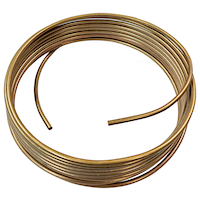
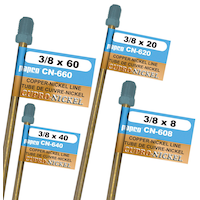
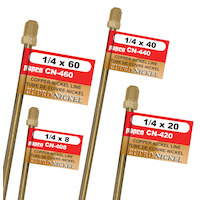
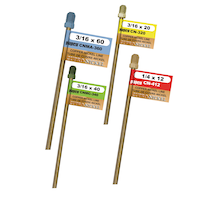
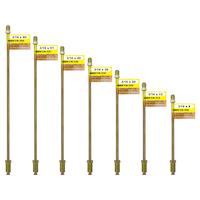
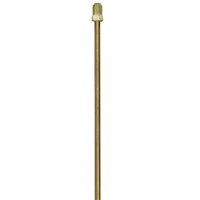
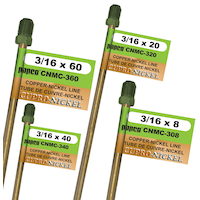
Cette conduite de frein pré-évasée de 25 pi H. Paulin est fabriquée à partir d'un alliage cupro-nickel qui contient 88 % de cuivre et 10 % de nickel. Le matériau permet à la ligne de 3/8 po d'être facilement pliée et évasée pendant l'installation et résiste beaucoup mieux à la rouille et aux dommages causés par le sel de voirie et les produits chimiques que les conduites en acier. Ses propriétés anticorrosion permettent de maintenir le bon fonctionnement de vos freins pendant plus longtemps.
Caractéristiques
Spécifications
Ressources
Conduite de frein en cuivre et nickel H. Paulin CN625 composée de cuivre (88 %), de nickel (10 %) et de fer (2 %), facile à plier et à évaser
Cupro-nickel rendant les conduites de frein faciles à plier et à évaser
Conduites en cupro-nickel beaucoup plus résistantes à la rouille et aux dommages causés par le sel de voirie et autres fondants à glace chimiques que les conduites en acier
Si cet article est défectueux, il est couvert par la garantie du fabricant. Dans le cas où aucune garantie n'est indiquée, cet article est couvert par une garantie de un an honorée dans tout magasin Canadian Tire.
Acheter des produits connexes
Offres hebdomadaires
Les clients ont aussi consulté
Vers les produits tendances
Plus de cette marque
Points saillants de l'evaluation
List of Avantages Highlights
Avantages
List of Désavantages Highlights
Désavantages
Impossible de générer un Désavantages approprié pour le moment.
Évaluations
Sommaire de la notation
Sélectionner une ligne pour filtrer les commentaires
5 étoilesétoiles
0
0 commentaires avec 5 étoiles.
4 étoilesétoiles
1
1 commentaires avec 4 étoiles.
3 étoilesétoiles
1
1 commentaires avec 3 étoiles.
2 étoilesétoiles
0
0 commentaires avec 2 étoiles.
1 étoileétoiles
0
0 commentaire avec 1 étoile.
Note générale
3.5
2 commentateurs sur 2 (100%) recommandent ce produit
Évaluez ce produit
Sélectionnez pour évaluer l'article à 1 étoile. Cette action ouvrira le formulaire de soumission.
Sélectionnez pour évaluer l'article à 2 étoiles. Cette action ouvrira le formulaire de soumission.
Sélectionnez pour évaluer l'article à 3 étoiles. Cette action ouvrira le formulaire de soumission.
Sélectionnez pour évaluer l'article à 4 étoiles. Cette action ouvrira le formulaire de soumission.
Sélectionnez pour évaluer l'article à 5 étoiles. Cette action ouvrira le formulaire de soumission.
Pour ajouter un avis, vous devrez fournir une adresse courriel valide à des fins de vérification.
Filtrer les avis
qualité
prix
sécurité
valeur
conception
réparations
en cas d'urgence
petit
Cote
Paramètre régional
1 to 2 sur 2 commentaire
1 – 2 sur 2 commentaire
Trier par
Les plus récents
4 étoile(s) sur 5.
10 months and 6,000 kms later, fuel line is fine.
il y a un an
Replaced rusty steel main fuel line with this copper nickel brake line, which is apparently safe and won't compromise fuel quality. 10 months and 6,000 kms later, and this line is holding fine. First time doing this job, and I would say this job is not for the faint of heart. Dealing with a rusty system, it's probably best to consider the worst case scenario first, so in this case, it would be replacing the entire fuel system from the engine block, back. Have to jiggle a rusty line? Prepare for it to break. Have to remove a rusty fuel tank strap? Prepare for the fuel tank to spring a leak. I look back at my hubris, and the small fortune it cost me in parts and tools.
Cutting out the fuel filter and old line wasn’t so bad. The line was really rusty and thin in one section and snapped during removal. Running new 3/8” copper-nickel line was a mess. My visions of turning 5 rusty straight lines into 5 shiny new straight lines running down the length of the car, quickly devolved into 4 rusty straight lines + 1 shiny curvy line running in erratic s-curves. Lots of mistakes made. First I started making the bends from the fuel filter side and then feeding the line up through the engine bay, but I should have started by feeding the line down from the engine bay, since this is the hardest turn to make. To be safe I cut the line a little long, but when I ended-up with too much line and tried to get it up through the engine, a kink almost started, so to save the line, and this line is not cheap, I had to let the line do a couple s-curves to relieve stress. Maybe if I had 4 jack stands, or had access to a lift, maybe these s-curves could have been avoided.
When I was ready to do the final push-connect flare for the fuel hose at the engine, the tool die got stuck on the formed metal. Took a break for several hours, and then realized that the hydraulic tool for making the flare is designed to be able to pull-out the stuck die. I had skipped a step in removing the dies. So, I was able to remove the die and finally connect the fuel line to the fuel hose in the engine. Before investing in this hydraulic flaring tool, I asked a shop if they could make the bends for me and they said they could, but I later decided against this because this is the same shop that installed the bad starter. Even with this mess, I don't regret this decision. This tool is nice.
Why did I end up going down this road? The car was running, but there was an intermittent short causing the fuel pump fuse to blow every now and then. I asked a friend, who used to be a mechanic, and his advice was to run new 14 gauge primary wire from the relay directly to the fuel pump. This is where the hubris comes in. I knew the fuel filter hadn't been changed in a decade, and the fuel level meter was also not working for years, so I knew there was something wrong with the fuel filter and fuel pump assembly, so my mind and my wallet were already racing to what I thought was the correct way to fix the problem, and I had seriously discounted my friend's advice as some kind of quick-fix. I had not considered the potential, and eventually realized, worst case scenario.
20:20 hindsight, instead of investing in a fancy tool for making push-connect flares for fuel lines, it would have been waaay better investing in a fancy power probe tool to better diagnose the obvious electrical problem. It would also have been waaay better taking on my friend's advice to begin with. Eventually, I determined there was a short in the fuel pump/ fuel injector circuit. The circuitous route to get here involved finding a circuit diagram that showed the fuel pump and the fuel injectors sharing the same circuit and thus the same fuse that was blowing. Inside the fuse box in the car, the fuse is clearly labelled as fuel pump/ fuel injector, but again, it took some learning to get here, and to understand the wiring implications.
If I had the fancy power probe tool at the beginning, but didn't consider that the fuel injectors also shared this circuit, I'm not sure I would have found the short if it was in one of the wires to the fuel injectors, which I think is the case. I might then still have balked at cutting and running new wire. If I went ahead anyway and cut and ran new wire, the car wouldn't have started due to no power to fuel injectors. Eventually, it would have dawned on me, I hope, that the fuel injectors shared this circuit, but who knows. Best case scenario, if I had taken my friend's advice, the repair would have cost me one roll of 25' primary wire, and some crimp connectors. Instead, it eventually cost me a new fuel system from the engine block, back, plus one roll of 25' primary wire, and some crimp connectors. Sure the car runs nice now, mostly, and everything works and is clean, but at what sunk cost in parts and tools. Chalk it up to learning experience? Yes, some of the experience transferred over when I recently replaced the rear brake brake lines and hoses. That's something.
Anywhoo, back to this copper nickel line. I believe this 3/8-in line is made in China. At least their 3/16-in line is made in China. But it comes with the H. Paulin brand, and I believe the Canadian Tire mechanics use this line, since I saw an open package of line on their parts shelf. Copper Nickel line can be had for less cost online at that behemoth online store, also made in China, but since this was my first time working with fuel line, I went with the trusted brand, and the trusted brick-and-mortar retailer. Cost more, but had fewer questions like wall thickness of line, percentage of nickel, quality control, ease of return policy, etc. Who knows, maybe it's the exact same line. If you know, let me know. Minus 1 star for value.
Lorsque vous consultez un site Web, des données peuvent être stockées dans votre navigateur ou récupérées à partir de celui-ci, généralement sous la forme de cookies. Ces informations peuvent porter sur vous, sur vos préférences ou sur votre appareil et sont principalement utilisées pour s'assurer que le site Web fonctionne correctement. Les informations ne permettent généralement pas de vous identifier directement, mais peuvent vous permettre de bénéficier d'une expérience Web personnalisée. Parce que nous respectons votre droit à la vie privée, nous vous donnons la possibilité de ne pas autoriser certains types de cookies. Cliquez sur les différentes catégories pour obtenir plus de détails sur chacune d'entre elles, et modifier les paramètres par défaut. Toutefois, si vous bloquez certains types de cookies, votre expérience de navigation et les services que nous sommes en mesure de vous offrir peuvent être impactés.
Charte de confidentialité de Canadian Tire
Cookies strictement nécessaires
Toujours actif
Ces cookies sont nécessaires au fonctionnement du site Web et ne peuvent pas être désactivés dans nos systèmes. Ils sont généralement établis en tant que réponse à des actions que vous avez effectuées et qui constituent une demande de services, telles que la définition de vos préférences en matière de confidentialité, la connexion ou le remplissage de formulaires. Vous pouvez configurer votre navigateur afin de bloquer ou être informé de l'existence de ces cookies, mais certaines parties du site Web peuvent être affectées. Ces cookies ne stockent aucune information d’identification personnelle.
Cookies pour une publicité ciblée
Actif
Ces cookies peuvent être mis en place au sein de notre site Web par nos partenaires publicitaires. Ils peuvent être utilisés par ces sociétés pour établir un profil de vos intérêts et vous proposer des publicités pertinentes sur d'autres sites Web. Ils ne stockent pas directement des données personnelles, mais sont basés sur l'identification unique de votre navigateur et de votre appareil Internet. Si vous n'autorisez pas ces cookies, votre publicité sera moins ciblée.
Cookies de performance
Actif
Ces témoins nous permettent de compter les visites et les sources de trafic afin de mesurer et d'améliorer les performances de notre site. Ils nous permettent de savoir quelles sont les pages les plus et les moins populaires et de voir comment les visiteurs se déplacent sur le site. Tous les renseignements recueillis par ces témoins sont agrégés et donc anonymes. Si vous n'autorisez pas ces témoins, les données agrégées ne tiendront pas compte de votre visite.
Cookies de fonctionnalité
Actif
Ces cookies permettent d’améliorer et de personnaliser les fonctionnalités du site Web. Ils peuvent être activés par nos équipes, ou par des tiers dont les services sont utilisés sur les pages de notre site Web. Si vous n'acceptez pas ces cookies, une partie ou la totalité de ces services risquent de ne pas fonctionner correctement.