

MotoMaster Eliminator
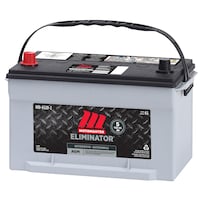
Motomaster 12V Eliminator Renewable Energy Deep Cycle Battery
#011-1879-8
$349.99
Plus $20.00 Core Charge
Top Rated
Unfortunately, this product is discontinued in your selected store and nearby stores.
You may be interested in these similar products shown below.Similar Items


Quebec residents: For information on maintenance and repair click here.


Product Details
- Features
- Resources
Motomaster 12V Eliminator Renewable Energy Deep Cycle Battery features a 12V sealed AGM (absorbed glass mat) deep cycle lead acid battery
Designed to be used with Xantrex PowerHub 1800 (11-1877) or as part of any battery bank for a renewable energy system
100 ah at 100 hour rate
100 ah at 100 hour rate
Warranty
This product carries a special warranty. Please see your local Canadian Tire store for details.
Shop Related Products
- Weekly Deals
- Customers Also Viewed
- Top Trending Products
- More From This Brand
Weekly Deals


Review Highlights
Reviews
Filter Reviews
- batteries
- instructions
- paperwork
- portable
- purchase
- value
Rating
Locale
1 to 2 of 2 Reviews
1 – 2 of 2 Reviews
Most Recent
4 out of 5 stars.
great for back up power
17 years ago
I tied this battery in with my portable power pack. It has lots of power for my tv and some lights
Yes, I recommend this product.
Helpful?
4 out of 5 stars.
Good Value; No Documentation
17 years ago
I use two of these batteries in my PV system at the cottage. They handle almost daily recharge after evening discharge. I have had no issues with the batteries after buying them this past spring; they still hold their charge fine. They are heavy, so the original installation was a bit strenuous.
The only criticism is that there is a complete lack of technical information included with the batteries for those who like to read the manual. Helpful information would include recommended charge setpoints, maximum charge rate, 20hr and 100hr ratings and more. Since these are undoubtedly a re-brand from a major battery manufacturer, I would expect the documentation to be available from the original supplier.
Yes, I recommend this product.
Helpful?
Questions
Start typing your question and we'll check if it was already asked and answered.
1 - 10 of 56 Questions
Most helpful answers
Q: Would this batterie or two of the exide 6 volts be better in my trailer for power? I need to replace my single 12 volt but cant get an answer weather or not this or the two 6 volts is a better set up? I dont have alot of room on the tounge of trailer but could fit either of these.
15 years ago5 Answers
A: for identically sized batteries.. the 6 volt batteries wired in series has a slight edge.. as the batteries wired in series keep their 'potential" a lot closer.. IE: 12 volt batteries wired in parallel usually work fine together, until they start to get older, then the one battery starts to "drain" into the other one (if one battery is more damaged or older then the other, it wont have the same "potential") sooo.. even though their is no draw on the batteries, they will discharge on their own.. this problem is less prevalent with batteries wired in series.. but in the "real" world, is usually not much of an issue, as long as you buy the batteries all at the same time (IE: dont mix old and new)
Anonymous15 years agoHelpful?
Q: does a deep cycle battery need to be completely discharged before it is recharged can a trickle charger be used to keep the deep cycle battery charged
14 years ago3 Answers
A: It's the opposite: Lead acid batteries don't like being discharged. I've seen the manufacturer's specification. It's something like: If only 20% of the capacity is used before recharging, it'll last 1000 cycles, If 50%, 600 cycles. If 80%, only 300 cycles. Clearly lead acid batteries prefer not to be discharged a lot.
11 years agoHelpful?
Q: I plan on using this battery in a truck camper. Can I charge it when I am driving by using heavy gauge wires from my truck battery to this battery?
15 years ago3 Answers
A: You need a battery isolator.
Anonymous15 years agoHelpful?
Q: i have an xantrex 240 system with solor panels and a back up generator for charging batteries.....can i use these batteries with the system? its a 48 volt system.....so I figure I would need four 12v batteries...am I correct and can I use these?
16 years ago3 Answers
A: Yes, this will work providing you wire your batteries properly. Do a web search on series and parallel battery wiring.
Anonymous15 years agoHelpful?
Q: 80 watts solar panel 1 have a 80 watt panel and my question is if i charge this battery for 1 week with full of sunlight should i get 14.3 volts or should it read 12.5 volts ?thanks
17 years ago3 Answers
A: 12.6 - 12.8V is usually considered a full charge at 25 celcius, if the battery has been at rest for 4 hours or so. It may read 14.3 volts while it's charging, but that number doesn't mean that much (the charging voltage has to be greater than the battery's voltage to get it to charge).
15 years agoHelpful?
Q: Exide or Eliminator? I could get two 6v Exide batteries from this web site for $240, and get 150 Ah ($1.60 per Ah), or I could get this Eliminator battery for $300, and only get 100Ah ($3 per Ah). Why would someone buy the Eliminator?
17 years ago3 Answers
A: The other guy is actually wrong about the exide thing, these battery's were designed and built by GNB, and were called absolite, they were first designed and intended for material handling in electric pallet trucks and stackers. they are also available in 6V from GNB the dimentions are exactly the same, I expect that they are built for exide by GNB
Anonymous14 years agoHelpful?
Q: What set points can this battery handle I have a solar system at the cottage. I use a morningstar 20A controller, with setpoints at 11.5 and 14.2 volts. With theses set points, will these batteries overcharge? Also, would 1 be enough to run a 19-inch LCD TV?
17 years ago3 Answers
A: The voltage setpoints sounds about right (not positive), but you should know these vary with the temperature. If it's less than 0 celcius, you should adjust them (Google it). 1 can put out about 700 watts for 1 hour, I believe that is enough for a 19" LCD! In fact, if it's about 100 watts, it should run for about 10 hours if the battery was fully charged.
15 years agoHelpful?
Q: New to solar and batteries - what next and how? I want to start moving to solar and battery use - having already moved entire house to spiral bulbs (huge energy saving over last 2 years), but am unable to find anyone in a Canadian Tire store to guide me as to what to buy and how to put it together. Does anyone know who I could go to for advise? With thanks, Jeannie
18 years ago3 Answers
A: Honestly, you are better off finding your local renewable energy expert and asking them. In Ontario, the best value is to grid-tie solar electric panels - but they must be professionally installed. They make back the money you put in them in about 14 years - it's a 20 year contract too, and the panels will last beyond that. It is very expensive however, expect to spend $20,000 or so (bigger = better payback). You'll need to keep the panels free of leaves and snow, but other than that, it's pretty maintenance free. The 2nd best for payback is solar thermal, used to heat the hot water your house uses. It's anywhere from 5k-10k, and there's a number of grants. Must be professionally installed for grants. Solar air heating is a possibility, and it's very simple, so it can be installed by a DIY. Not sure about the payback. About $1200 per panel installed. As a tinkerer, you can get solar panels, turbines, and batteries and run your own off-grid system, but you will need to monitor it. When not much power is generated, you'll have to switch loads back to the house's power. It will require a lot of researching to make sure you do it right. You may want to get a subscription to Home Power for examples and tips.
15 years agoHelpful?
Q: Why so expensive? What makes this better for a renewable energy system than less expensive batteries?
Anonymous18 years ago3 Answers
A: These batteries have THICK lead plates in them and are good for a LOT of deep discharge/recharge cycles. Probably about 1000 or more. A regular high end car battery, for example, will be completely dead if you discharge it all the way and recharge it about a dozen times. A marine deep cycle battery will last for maybe a couple of 100 full discharge cycles. These are similar to forklift batteries and are intended to be discharged and recharged often, so the lead plates are a LOT thicker and last a lot longer. It is a VERY heavy battery.
18 years agoHelpful?
Q: CCA? I have a '95 Discovery that I took the 3.9Ltr V/8 out of and put a 300TDi in. With the higher Compression on the Diesel, it won't start when it gets to 0degrees C. So, the 750CCA I have isn't enough. We need about 1200CCA.
11 years ago2 Answers
A: 1200CCA? Wow, that's a lot of CCA. Seems extreme for 0 degree starting. Based on what I've found researching some online forums and even checking Halfords website in the UK (where the 300 TDI is more commonly found), you really shouldn't need more than 850-900 CCA. Some online forums suggest the OPTIMA RedTop 34/78 works fine. This battery is 800 CCA. Canadian Tire's part # is 10-0011. Personally I'd go with the Eliminator Ultra XD model 10-7850. This is just about the best battery money can buy. It's rated at 880 CCA. Both of these batteries are high performance AGM so you can't just look at the CCA rating and compare it to a typical flooded battery. You also have to consider that they run at a slightly higher voltage which gives them outstanding 5-second output for cranking and a whole lot of other benefits that just makes starting, at any temperature, easier.
11 years agoHelpful?
1 - 10 of 56 Questions