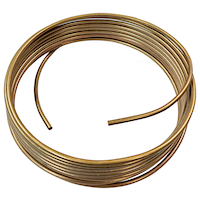
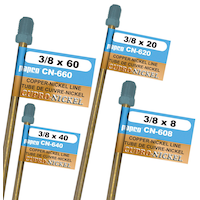
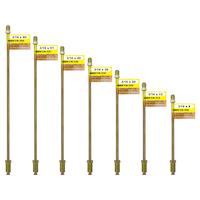
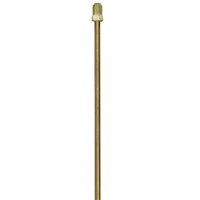
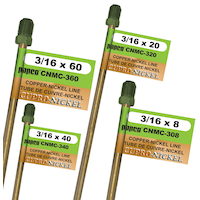
This 25-foot pre-flared brake line from H. Paulin is crafted from a cupro-nickel alloy containing 88% copper and 10% nickel. The material allows the 3/8-inch line to be easily bent and flared during installation while being far more resistant to rust and damage from road salt and chemicals compared to steel lines. The corrosion-resistant properties mean this line will help keep your brakes functioning smoothly for longer.
Features
Specifications
Resources
H. Paulin CN625 Copper Nickel Brake Line is made of 88% Copper, 10% Nickel, and 2% Iron, Cupro-Nickel Brake Lines are easy to bend and flare
Cupro-Nickel Brake Lines are easy to bend and flare
Compared to steel lines, Cupro-Nickel brake lines are far more resistant to rust and damage caused by road salt and other ice-melting chemicals
This product carries a 1 year exchange warranty redeemable at any Canadian Tire store.
Shop Related Products
Weekly Deals
Customers Also Viewed
Top Trending Products
More From This Brand
Review Highlights
List of Pros Highlights
Pros
List of Cons Highlights
Cons
Suitable Cons could not be generated at this time.
Reviews
Rating Snapshot
Select a row below to filter reviews.
5 starsstars
0
0 reviews with 5 stars.
4 starsstars
1
1 review with 4 stars.
3 starsstars
1
1 review with 3 stars.
2 starsstars
0
0 reviews with 2 stars.
1 starstars
0
0 reviews with 1 star.
Overall Rating
3.5
2 out of 2 (100%) reviewers recommend this product
Review this product
Select to rate the item with 1 star. This action will open submission form.
Select to rate the item with 2 stars. This action will open submission form.
Select to rate the item with 3 stars. This action will open submission form.
Select to rate the item with 4 stars. This action will open submission form.
Select to rate the item with 5 stars. This action will open submission form.
Adding a review will require a valid email for verification
Filter Reviews
price
quality
for emergencies
repairs
safety
small
accessibility
value
Rating
Locale
1 to 2 of 2 Reviews
1 – 2 of 2 Reviews
Sort by
Most Recent
4 out of 5 stars.
10 months and 6,000 kms later, fuel line is fine.
a year ago
Replaced rusty steel main fuel line with this copper nickel brake line, which is apparently safe and won't compromise fuel quality. 10 months and 6,000 kms later, and this line is holding fine. First time doing this job, and I would say this job is not for the faint of heart. Dealing with a rusty system, it's probably best to consider the worst case scenario first, so in this case, it would be replacing the entire fuel system from the engine block, back. Have to jiggle a rusty line? Prepare for it to break. Have to remove a rusty fuel tank strap? Prepare for the fuel tank to spring a leak. I look back at my hubris, and the small fortune it cost me in parts and tools.
Cutting out the fuel filter and old line wasn’t so bad. The line was really rusty and thin in one section and snapped during removal. Running new 3/8” copper-nickel line was a mess. My visions of turning 5 rusty straight lines into 5 shiny new straight lines running down the length of the car, quickly devolved into 4 rusty straight lines + 1 shiny curvy line running in erratic s-curves. Lots of mistakes made. First I started making the bends from the fuel filter side and then feeding the line up through the engine bay, but I should have started by feeding the line down from the engine bay, since this is the hardest turn to make. To be safe I cut the line a little long, but when I ended-up with too much line and tried to get it up through the engine, a kink almost started, so to save the line, and this line is not cheap, I had to let the line do a couple s-curves to relieve stress. Maybe if I had 4 jack stands, or had access to a lift, maybe these s-curves could have been avoided.
When I was ready to do the final push-connect flare for the fuel hose at the engine, the tool die got stuck on the formed metal. Took a break for several hours, and then realized that the hydraulic tool for making the flare is designed to be able to pull-out the stuck die. I had skipped a step in removing the dies. So, I was able to remove the die and finally connect the fuel line to the fuel hose in the engine. Before investing in this hydraulic flaring tool, I asked a shop if they could make the bends for me and they said they could, but I later decided against this because this is the same shop that installed the bad starter. Even with this mess, I don't regret this decision. This tool is nice.
Why did I end up going down this road? The car was running, but there was an intermittent short causing the fuel pump fuse to blow every now and then. I asked a friend, who used to be a mechanic, and his advice was to run new 14 gauge primary wire from the relay directly to the fuel pump. This is where the hubris comes in. I knew the fuel filter hadn't been changed in a decade, and the fuel level meter was also not working for years, so I knew there was something wrong with the fuel filter and fuel pump assembly, so my mind and my wallet were already racing to what I thought was the correct way to fix the problem, and I had seriously discounted my friend's advice as some kind of quick-fix. I had not considered the potential, and eventually realized, worst case scenario.
20:20 hindsight, instead of investing in a fancy tool for making push-connect flares for fuel lines, it would have been waaay better investing in a fancy power probe tool to better diagnose the obvious electrical problem. It would also have been waaay better taking on my friend's advice to begin with. Eventually, I determined there was a short in the fuel pump/ fuel injector circuit. The circuitous route to get here involved finding a circuit diagram that showed the fuel pump and the fuel injectors sharing the same circuit and thus the same fuse that was blowing. Inside the fuse box in the car, the fuse is clearly labelled as fuel pump/ fuel injector, but again, it took some learning to get here, and to understand the wiring implications.
If I had the fancy power probe tool at the beginning, but didn't consider that the fuel injectors also shared this circuit, I'm not sure I would have found the short if it was in one of the wires to the fuel injectors, which I think is the case. I might then still have balked at cutting and running new wire. If I went ahead anyway and cut and ran new wire, the car wouldn't have started due to no power to fuel injectors. Eventually, it would have dawned on me, I hope, that the fuel injectors shared this circuit, but who knows. Best case scenario, if I had taken my friend's advice, the repair would have cost me one roll of 25' primary wire, and some crimp connectors. Instead, it eventually cost me a new fuel system from the engine block, back, plus one roll of 25' primary wire, and some crimp connectors. Sure the car runs nice now, mostly, and everything works and is clean, but at what sunk cost in parts and tools. Chalk it up to learning experience? Yes, some of the experience transferred over when I recently replaced the rear brake brake lines and hoses. That's something.
Anywhoo, back to this copper nickel line. I believe this 3/8-in line is made in China. At least their 3/16-in line is made in China. But it comes with the H. Paulin brand, and I believe the Canadian Tire mechanics use this line, since I saw an open package of line on their parts shelf. Copper Nickel line can be had for less cost online at that behemoth online store, also made in China, but since this was my first time working with fuel line, I went with the trusted brand, and the trusted brick-and-mortar retailer. Cost more, but had fewer questions like wall thickness of line, percentage of nickel, quality control, ease of return policy, etc. Who knows, maybe it's the exact same line. If you know, let me know. Minus 1 star for value.
Yes, I recommend this product.
Helpful?
3 out of 5 stars.
Pricy
3 years ago
Way over priced compared to other suppliers. Should revisit the pricing. Very good quality tubing
When you visit any website, it may store or retrieve information on your browser, mostly in the form of cookies. This information might be about you, your preferences or your device and is mostly used to make the site work as you expect it to. The information does not usually directly identify you, but it can give you a more personalized web experience. Because we respect your right to privacy, you can choose not to allow some types of cookies. Click on the different category headings to find out more and change our default settings. However, blocking some types of cookies may impact your experience of the site and the services we are able to offer.
Canadian Tire Privacy Charter
Strictly Necessary Cookies
Always Active
These cookies are necessary for the website to function and cannot be switched off in our systems. They are usually only set in response to actions made by you which amount to a request for services, such as setting your privacy preferences, logging in or filling in forms. You can set your browser to block or alert you about these cookies, but some parts of the site will not then work. These cookies do not store any personally identifiable information.
Targeting Cookies
Allow
These cookies may be set through our site by our advertising partners. They may be used by those companies to build a profile of your interests and show you relevant adverts on other sites. They do not store directly personal information, but are based on uniquely identifying your browser and internet device. If you do not allow these cookies, you will experience less targeted advertising.
Performance Cookies
Allow
These cookies allow us to count visits and traffic sources so we can measure and improve the performance of our site. They help us to know which pages are the most and least popular and see how visitors move around the site. All information these cookies collect is aggregated and therefore anonymous. If you do not allow these cookies, the aggregated data will not include your visit.
Functional Cookies
Allow
These cookies enable the website to provide enhanced functionality and personalisation. They may be set by us or by third party providers whose services we have added to our pages. If you do not allow these cookies then some or all of these services may not function properly.